Names, Renames, and Cartography
’Tis but thy name that is my enemy:
Thou art thyself, though not a Montague,
What’s Montague? It is not hand nor foot,
Nor arm nor face. O be some other name,
belonging to a man!
What’s in a name? That which we call a rose,
By any other word would smell as sweet.
- William Shakespeare, Romeo and Juliet (Quarto 2, 1599)
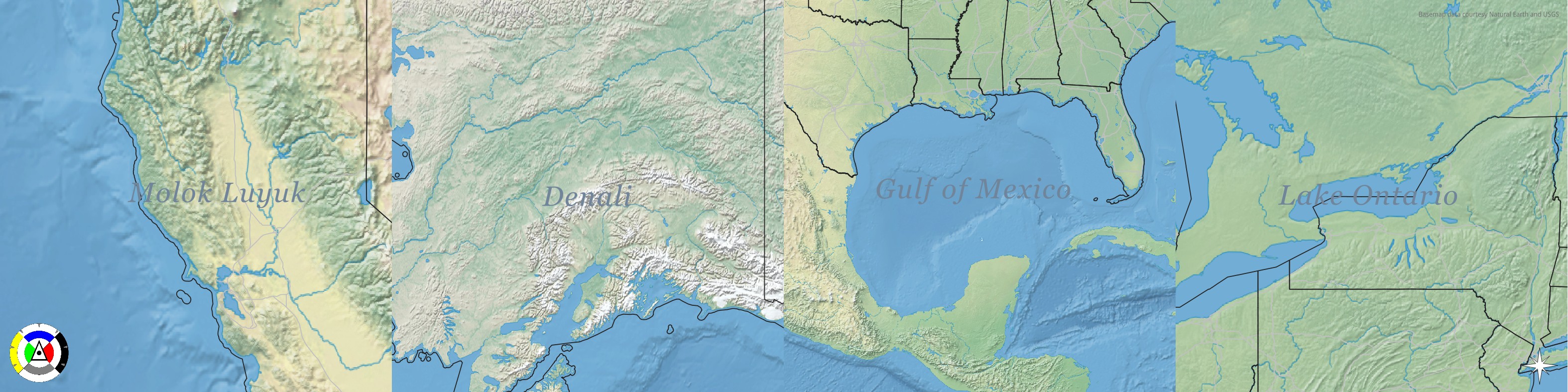
Walker Ridge, Denali, Gulf of Mexico, and Lake Ontario
What do the above four toponyms (place names) have in common? All four are places within or partly-within the territorial boundaries of the United States, and have been renamed by Executive Order or Proclamation of U.S. presidents. Walker Ridge was renamed to Molok Luyuk, Denali - Mount McKinley, Gulf of Mexico became Gulf of America, and Lake Ontario most recently was renamed Lake America. Two presidents, three years, four toponyms. All four are updated to the new names in the official U.S. database of domestic names.
BGN and GNIS
This post began with a simple observation and question - in the latest spat with Canada over a multitude of unhinged complaints, Donald Trump issued an executive order on 27 August, 2026 renaming Lake Ontario to Lake America. Not long after, I began seeing social media posts screencapping Google Maps having already updated the name, at least for U.S. users. Google tends to use official sources for toponyms, so I wondered if those sources had been updated, or if Google was “complying in advance.” As it turns out, the official U.S. government sources were updated shortly after the EO, so while Google’s choice was still questionable, it was at least not complying in advance.
The official source of toponyms for the U.S. government is the Geographic Names Information System (GNIS). This was established in the late 1970s, as part of the modernization and standardization of toponyms for the U.S., and the names are curated by the Board on Geographic Names (BGN). Accordingly, all 981,706 domestic toponyms in GNIS are given a designation as “official” or “unofficial,” and a note on the authority under which a name has been assigned. There are five designations for the authority a name has been assigned under:
- Board Decision
- Congressional Legislation
- Executive Order
- Secretarial Order
- Undefined
The vast majority of these names (900,000+) are marked as ‘Undefined’ authority, mainly names no one has needed to redefine. Odds are, if you talk to a local about these places, they will recognize the name from GNIS, and it has “always” been named that. About 6 percent of the names (55,000+) have been assigned on the authority of the Board – these names apparently needed some official disambiguation, and that is part of the reason the Board exists. Several hundred (~600) have been assigned by Secretarial Order (other official disambiguation), and 81 by legislation. Only the four places named above have been designated under executive order – 0.000004 percent. All four were renamed within the past three years. Molok Luyuk was renamed under President Biden, the other three by Trump.
Walker Ridge/Molok Luyuk
Molok Luyuk means Condor Ridge in Patwin, and was a traditional name for the landform also known as Walker Ridge near Clearlake, California. In May of 2024, President Biden issued Proclamation 10745 expanding Berryessa Snow Mountain National Monument to include the ridge, naming it by that ancestral name but noting it was also known as Walker Ridge. This name was updated in GNIS, and is now the official designation on U.S. government maps and publications. The renaming was the continuation of long-term efforts to acknowledge Native American heritage and traditional ownership, and western U.S. news sources and conservation organizations reported favorably on it.
Denali/Mount McKinley
Denali was the name then in use for the mountain in 1896, Anglicized from Koyukon. In that year, gold prospector William Dickey renamed it Mount McKinley in honor of then-presidential candidate William McKinley. This precipitated efforts to restore the name Denali, which the State of Alaska did in 1975, though the Federal government did not follow suit until 2015. Trump reverted that in 2025 under Executive Order 14172. The “restoration” of the name McKinley was not only opposed by Native Alaskans but also by other locals of the state – including both Republican senators from Alaska. The name change went through, anyway.
Gulf of Mexico/Gulf of America
In the midst of a racist campaign of mass deportation of Hispanic people and any other non-whites, and a budding irrational trade war with both Canada and Mexico, the same order was used to rename the Gulf of Mexico to the Gulf of America. This was widely seen as petty and performative, prompting ridicule including from early internet mapping pioneer MapQuest. They offered a template for anyone who wanted to rename the gulf themselves. This renaming has largely been seen as absurd and juvenile.
Lake Ontario/Lake America
The most recent renaming is the culmination of yet more unwarranted anti-Canadian sentiment from the White House, precipitated by trade disputes and (rather inexplicably) wildfire smoke. Executive Order 14422 was signed on 27 August, 2026, and GNIS was updated shortly thereafter. This apparently lead to Google’s update that initially brought all of this onto my radar. No one asked for this change, except perhaps in Trump’s brain… a place I refuse to contemplate for my own mental health. Mapquest has also made a renaming tool for this as well.
Final Thoughts
Four toponyms, four places, renamed from what they had been known as for decades. One of these was renamed to restore an ancestral name predating Euro-American colonization. The other three are erasures — in the case of Gulf of Mexico/Lake Ontario, they are erasing contemporary names that preserved, however imperfectly, ancestral names. In the case of Denali, the renaming actually erased an ancestral name that had just recently been restored.
The replaced names all had history on their side. Only the renaming Molok Luyuk also has history on its side. It restores a history that was suppressed by settlers, while the other three are themselves suppression. There is a reason the first place officially renamed by executive authority alone occurred in 2024 – the reason is discourse. Like the many elements of our government officially entrusted to Congress, what we call things deserves debate and discussion. Molok Luyuk got a discourse, and input from some of the people who traditionally used the place. The renaming of Denali in 2015 was the result of 40 years of pushing for that. The discourse on the three recent renamings was intentionally short-circuited by the EOs. The Gulf, Denali, and the Lake were autocratically decreed new names to fit the petty whims of a man who should be in jail. Names belong to the people, in any case – and it seems clear quite a few disagree with most of these renamings.
Rule #39: What you say and how you say it matters. Words have meaning, names have power.